The path down to Nongriat starts as a stone staircase behind a village schoolhouse in Tyrna, at the edge of the Cherrapunji plateau. Three thousand five hundred steps later, if your knees have held up, you will arrive at a village of fewer than a hundred people, built beside a river the colour of a swimming pool.
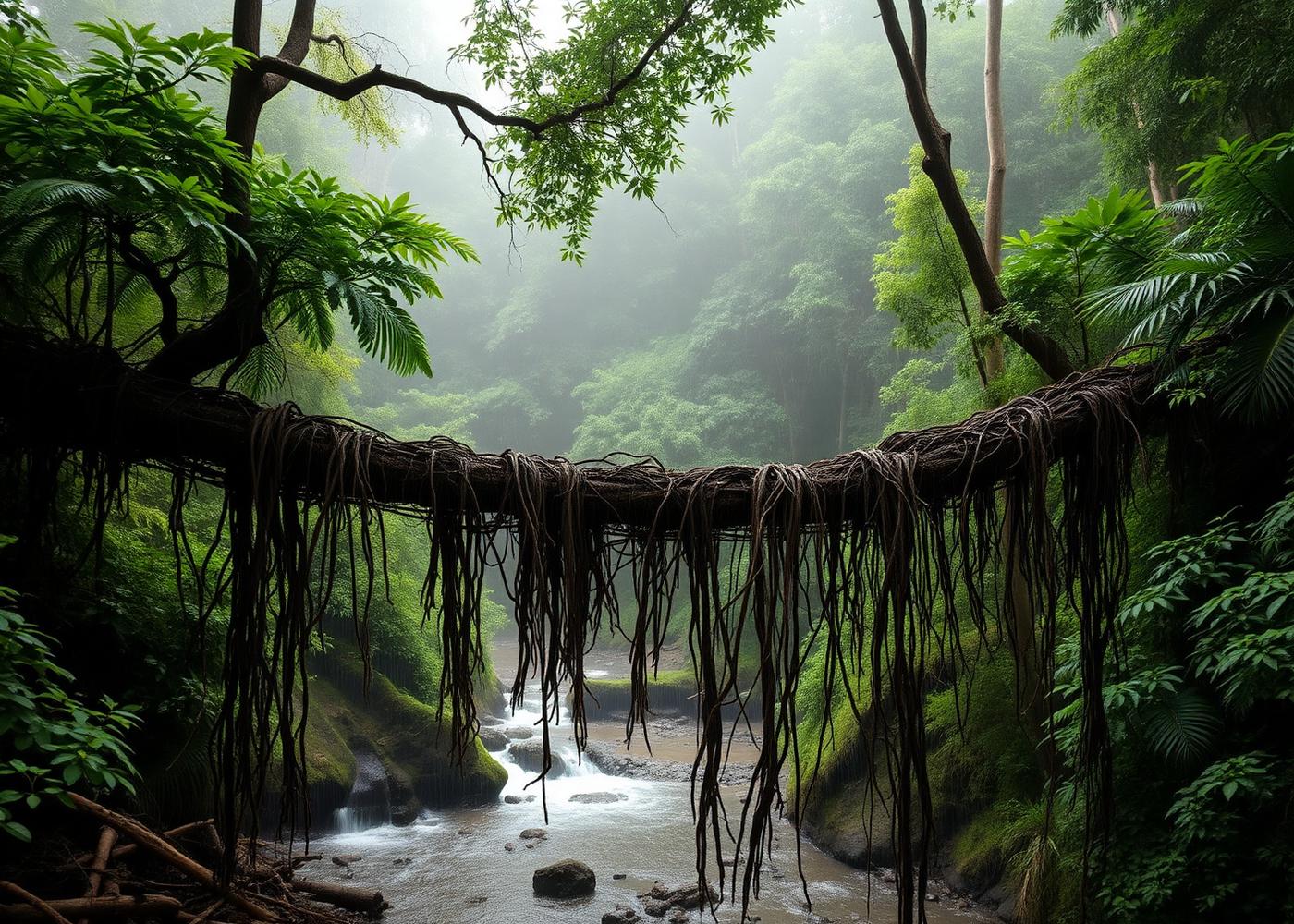
The bridges here are alive. They are the aerial roots of the Ficus elastica tree, coaxed across streams by generations of the Khasi people, patiently guided along bamboo scaffolding until they root on the far bank and thicken into a walkway strong enough to carry ten adults at once. Some of the bridges in Nongriat are over 180 years old. They are still growing.
Why they exist at all
The Khasi hills receive more rain than almost anywhere else on earth. Cherrapunji and nearby Mawsynram trade the world record for annual rainfall between them each year — routinely over 11,000 millimetres. In that kind of water, a wooden bridge across a monsoon-swollen stream would rot in a season. A steel bridge would rust.
So the Khasis did something extraordinary. Sometime in the last thousand years — nobody knows exactly when — they realised that the aerial roots of the local Ficus tree could be trained across a stream, encouraged along a hollowed betel-nut trunk laid as a temporary bridge, and left to grow into permanent architecture. The result gets stronger every year, not weaker. A monsoon that would destroy a conventional bridge only feeds it.
The trek: what to actually expect
Getting to Nongriat is not a stroll. From Sohra (Cherrapunji) you drive about 25 minutes to Tyrna village. From there it is a descent of roughly 3,500 uneven stone steps to the valley floor, then two suspension bridges over the Umshiang river, and a final climb to Nongriat village. In dry conditions, allow two and a half hours down. In wet conditions, three to four — and be honest about your knees.
The climb back out is the harder half. It is the same 3,500 steps in reverse, gaining roughly 700 metres of elevation in around four kilometres. Most trekkers take three to four hours to return. This is why a good itinerary always includes a night at Nongriat — attempting it as a day trip means walking down and back up in one push, which most people regret by step 2,000.
The double-decker and Rainbow Falls
The famous double-decker root bridge sits about fifteen minutes' walk beyond Nongriat village. It is exactly what it sounds like — two root bridges layered one above the other, both fully functional. Local guides say the upper deck was added around 1960 when flood waters made the lower one dangerous during the peak monsoon.
If you have a second day, walk another two and a half hours upstream to Rainbow Falls. This is the trek most people miss because it does not appear in Instagram posts, but it is the payoff of the entire journey. The falls plunge into a natural pool with, on a sunny morning, a permanent rainbow suspended in the mist. You can swim. Most people do.
Where to sleep in Nongriat
There are four or five family-run guest houses in the village. Serene Homestay is the best known, run by Byron Nongrum, whose family has hosted trekkers for two decades. Rooms are basic — a bed, a mosquito net, a shared bathroom with a bucket shower — but the food is genuinely excellent. Dal, rice, freshly-picked greens, sometimes river fish. Dinner is served communally around 7 PM, when the village generator kicks in for two hours.
Book directly with the homestay rather than through an online aggregator. The village has patchy mobile signal but WhatsApp usually works. Or let a Meghalaya specialist handle it — Byron speaks limited English and phone bookings can get lost in translation.
The best season, and the honest one
October to April is the tourist season. Skies are largely clear, the trek is dry, and the river runs low enough to swim in the pools. This is when most guests visit and when the village is at its liveliest.
But the root bridges were built for the monsoon, and if you have the appetite for it, June to September is the more honest experience. The forest is at its greenest, the waterfalls at full volume, and the temperature drops to a manageable 20 to 24 degrees. You will get wet — really wet — but you will also understand why these bridges exist.
Avoid the very peak of the monsoon in July if you can, when the trail becomes genuinely dangerous with landslides.
Responsible trekking in a fragile place
Nongriat is a village of ninety-odd people receiving an increasing volume of trekkers each year. The pressure is real. Carry every scrap of your plastic back up with you — the village has no waste system and burns whatever gets left behind. Ask permission before photographing anyone. Pay the guest house rate they quote without haggling; it is already modest for the work involved. And if you can, hire a local Khasi guide from Tyrna village for the descent — it puts money directly into the community that maintains these bridges.
Frequently asked
How fit do I need to be for the Nongriat trek?
You do not need to be an athlete, but you need to be honest about your knees on 3,500 stone steps. A good rule: if you can walk 8 kilometres of hilly terrain without stopping, you can do this trek with an overnight in the middle.
How many days should I plan for Meghalaya?
Minimum 5 nights. Two nights in Shillong, two in the Cherrapunji area (one at Nongriat), and one buffer. A week is better if you want to also see the caves and the crystal-clear river at Dawki.
Are the root bridges safe to walk on?
Yes. The main bridges support the daily foot traffic of the village and have done so for over a century. Trust the roots; they are much stronger than they look.