The Brahmaputra does not behave like other rivers. In its Assam stretch, it is over ten kilometres wide in places, braided into a shifting maze of sandbars and islands that no map can hold still for more than a season. To travel down it is to travel through a landscape that reinvents itself each monsoon.
A week aboard one of the shallow-draft cruisers — the Charaidew II, the Mahabaahu, the Ganga Vilas on its Assam legs — is the closest thing India has to an African river safari. Days are unhurried. You wake to mist over the water, birdwatch from the top deck with a coffee, disembark by launch to a tea garden or a village, and by six you are back on board watching the sun set behind a distant sandbank while the anchor drops in the middle of the river.
Where the boats go
The classic route is Guwahati to Neamati Ghat (near Jorhat), a seven-night eastbound voyage of roughly 350 kilometres. The reverse — Jorhat to Guwahati, westbound — is a shorter five-night option that takes advantage of the current. Most operators run both directions across the season.
Guwahati is the natural starting point for international guests: fly in, spend a night, board in the morning. Jorhat has its own airport for the eastern end, and combines beautifully with two nights in the Jorhat tea gardens before or after.
Majuli, the vanishing island
Majuli is the largest river island in the world — a 350-square-kilometre landmass in the middle of the Brahmaputra, home to about 170,000 people, mostly of the Mishing tribe and the Vaishnavite monastic community. It is also shrinking. Erosion during each monsoon takes another chunk of the island, and current estimates give Majuli another 15 to 20 years before it becomes uninhabitable.
The cruise stops at Majuli for a full day. The essential visit is to one of the satras — the neo-Vaishnavite monasteries founded in the 15th century by the reformer Sankardev. Auniati and Kamalabari are the two most active. The younger monks still practice the sattriya dance tradition, and a small performance for visiting guests is part of most cruise itineraries.
The other essential stop is a Mishing village on stilts — every house raised two metres off the ground on bamboo posts, because the monsoon floods reliably reach the doorstep each year.
Wildlife from the deck
The Brahmaputra is the last refuge of the Gangetic river dolphin in Assam. Population estimates put around 300 to 400 dolphins across the river's length. From the deck of a slow cruiser you will see them — never for long, always a brief silvery arc breaking the surface before disappearing again — but reliably, most mornings.
The birding is spectacular in winter. From November onwards the river hosts bar-headed geese (migrating from Central Asia over the Himalayas), ruddy shelducks, black-necked storks, and dozens of species of duck. Bring binoculars.
Most cruises include one or two land-based safari drives into Kaziranga National Park from the river bank. This is the best of both worlds — the slow river experience combined with proper jungle wildlife.
The tea garden stops
Assam produces roughly half of India's tea and about 13% of the world's. Unlike Darjeeling's small delicate leaves grown at high altitude, Assam tea is a lower-altitude, higher-yield crop with a stronger malty character — the tea in your English breakfast blend at home.
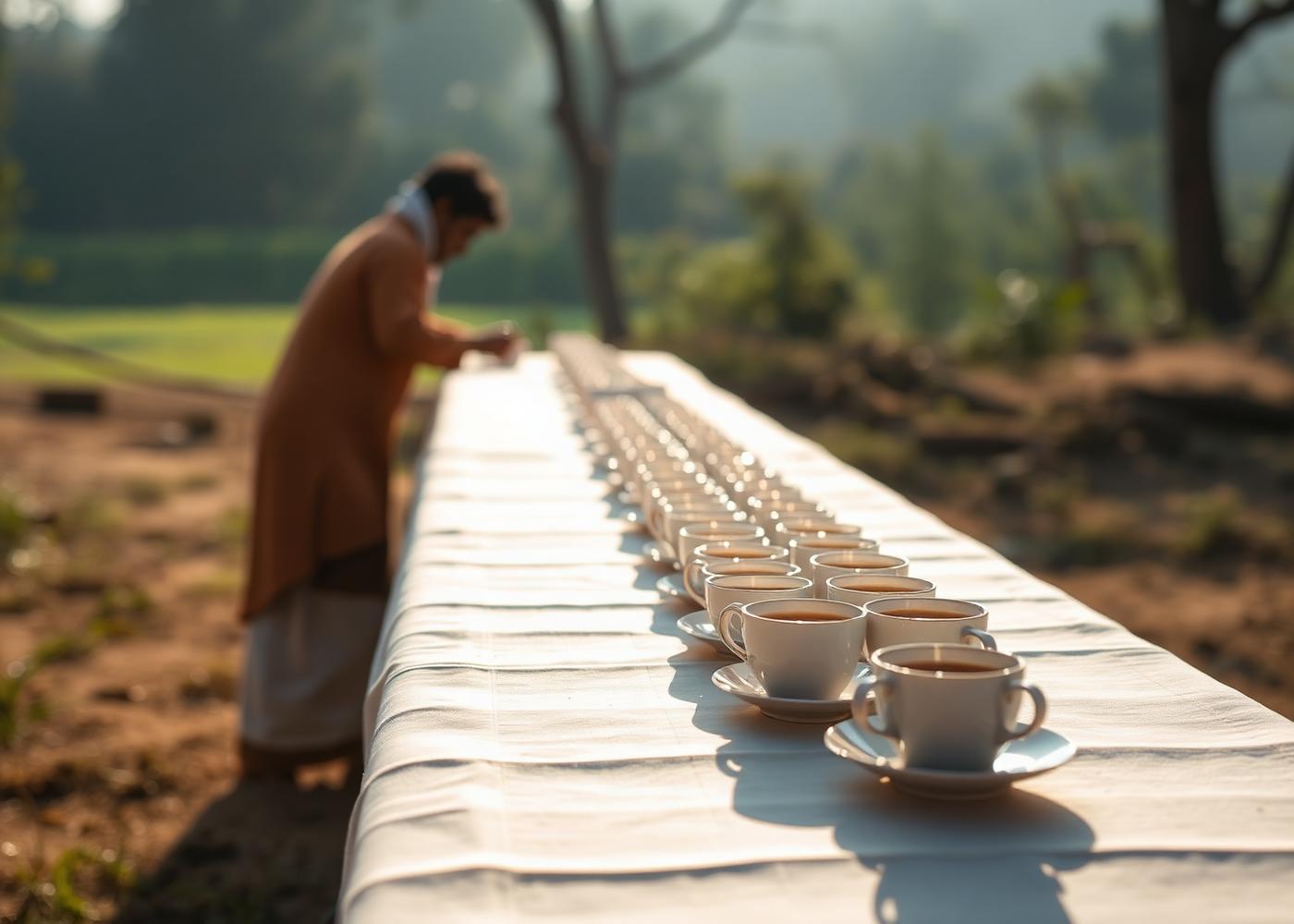
A cruise routinely stops at one or two tea estates. Manohari, Silonijan, and Sangsua are common choices near the Jorhat end. Do not expect Darjeeling-style delicacy in the tasting; expect a robust, thick-liquored cup that hits harder and demands milk. It is honest tea, and eating a factory-fresh CTC brew with a plate of pitha (Assamese sweet rice cake) is one of the small joys of the trip.
The boats, honestly
There are essentially three cruise operators worth considering. Assam Bengal Navigation (the Charaidew II) is the specialist's choice — small ship (24 guests), knowledgeable naturalists, unpretentious atmosphere, and a proven track record over two decades. Mahabaahu is the more luxurious option with a spa, larger cabins, and a higher price. Ganga Vilas is the newer entrant, longer and more corporate.
Cabins on all three are comfortable rather than luxurious. Air conditioning, private bathroom, big picture window. The point is not the room; the point is the deck and the river beyond it.
When to sail
The season runs October to April. October and November are the freshest — post-monsoon, high water levels, and the migratory birds just arriving. January and February are the coolest and clearest. March and April are warmer but combine beautifully with a Kaziranga safari extension. Avoid May onwards, when the monsoon begins and water levels become unpredictable.
Frequently asked
Is a Brahmaputra cruise a good first trip to Assam?
Yes, and it is often the best way to introduce first-time visitors to the region. The pace is gentle, the food is excellent, and it removes the friction of moving between hotels every night.
How many days should I add on land?
At minimum, two nights in Kaziranga either before or after the cruise. A longer trip adds Meghalaya (three nights) and Nagaland (three nights) for a proper 12-14 day North East India journey.
Is the cruise good for children?
Yes, from about age eight upward. Younger children may find the pace slow.